Travel to Greece
Day 5 Meteora - Arta - Nafpaktos (315 Km.)
(in 1 Km.) Meteora: One of our goals of the trip to Greece was to visit Meteora. The Meteora Monasteries (Μετέωρα Μοναστήρια; that is to say; Monasteries suspended from the sky) are located north of Greece, on the Plain of Thessaly, near Kalambaka, in the valley of the Peneo River. They are classified as World Heritage by UNESCO since 1988. They are constructions on the summit of gray rock masses (sandstone and conglomerate), carved by erosion and called Meteora. They are at a height of 600 meters and are inhabited since the fourteenth century. The first monasteries were founded in the fourteenth century, were built in order to escape the Turks and Albanians of the time. Up to a total of 24 monasteries, at the height of the peak in the fifteenth century, occupied the boulders of the region. Only six monasteries are in use today.
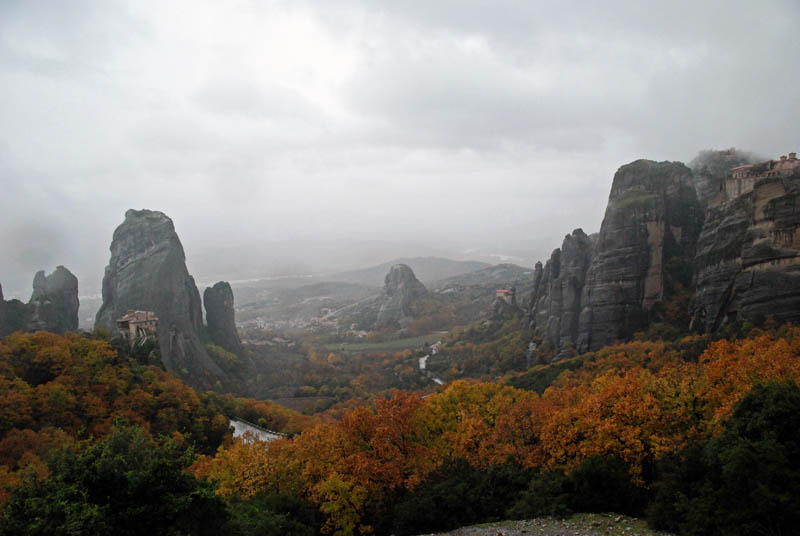
Meteora
Unfortunately, the weather forecast was not wrong and the day was rainy. After an excellent breakfast, before starting the visit to the monasteries, we go to the two viewpoints in the lower part, the viewpoints of Kastraki and Kalambaka. After making a couple of photos covered under our umbrella, we begin the ascent along the road that leads to the monasteries and in just 700 meters we reach the first, the Monastery of St. Nicholas Anapausas (Αγιος Νικόλαος, Àgios Nikólaos). When planning the visit of the monasteries, it is important to check beforehand the days that each one closes and its schedules. Because of this we were unable to visit the monastery of the Great Meteor. The entrance to each of the monasteries cost € 3.
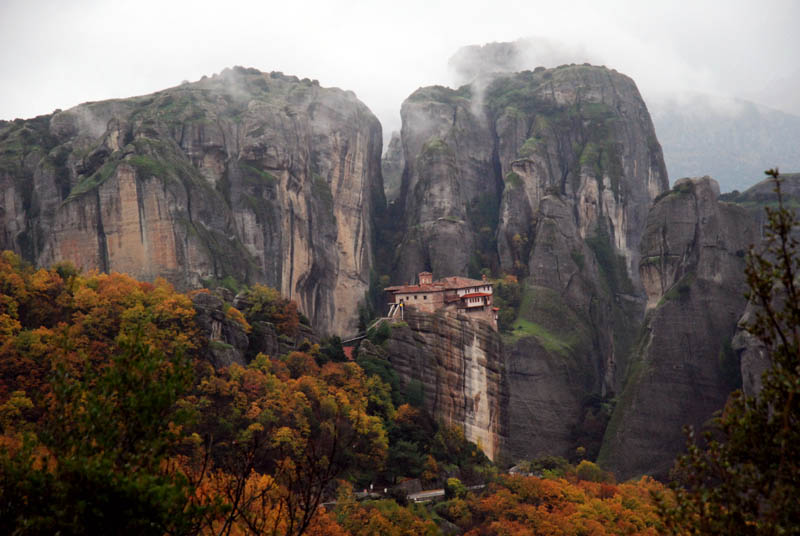
Meteora - Roussanou Monastery
The Monastery of St. Nicholas Anapausas is at the top of an 80 meter high rock formation. To ascend, you must travel a steep path, very close to the cliff, which is composed of 143 steps and a staircase with 85 steps carved into the rocky wall itself. The Monastery of St. Nicholas is distinguished by its design, adapted to the small extent of the space in which it is built, with successive floors. On the ground floor of the monastery is the chapel of San Anthony, from the 14th century, with traces of hagiographies and a crypt. On the first floor is the katholikón. The decoration of this plot is the work of Theophanes of Crete. On the upper floor are the archonaki, the ossuary and a chapel dedicated to John the Baptist. It is believed that a first core of buildings dates back to the 13th century. Roussanou Monastery occupies the entire plateau at the top of the rock where it is located. It has three stories, with the katholikón, the archontariki and several cells arranged on the ground floor, as well as other cells and auxiliary spaces on the other floors. The church is an Athonite type cross temple with a simple (Nartex with a dome) Hagiographies from 1560. The access to the monastery is by stairs and two bridges, which were built in 1930. In addition to the monasteries, the viewpoints stand out, especially the one located on the road in the direction of the monasteries of St. Stephen and the Holy Trinity, an ideal place to watch the sunset.
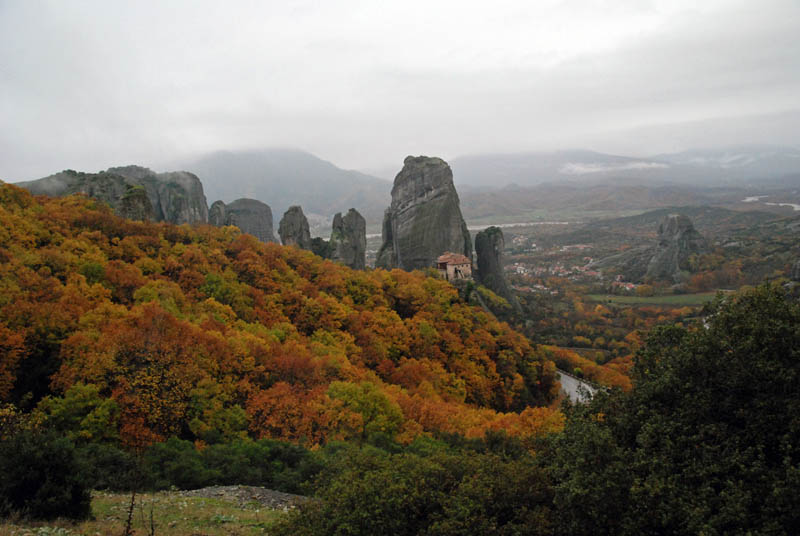
Meteora
The monastery of St. Stephen, like Roussanou, is one of the two monasteries of Meteora run by nuns. The settlement of the monks on the cliff of St. Stephen began at the end of the twelfth century. The monastery took its current form with the buildings built in the eighteenth and nineteenth centuries. It is connected to the modern road with a small bridge. The monastery cells are located on both sides of the main entrance. To the southeast is the old church of the monastery, dating from the fifteenth century. It is a small church, with a single nave, decorated with simple elements, the work of Nicholas Kastrinsio. The new church is located in the northwest of the enclosure and dates from 1798. The Holy Trinity monastery was founded between the 14th and 15th centuries. The plan of the church is shaped like a cruciform and has a dome supported by two columns. The main cathedral of the monastery was built in the fifteenth century and is decorated with frescoes in 1741 made by two monks. It has white columns and arches, as well as pink tiles. Its wide narthex was built in 1689 and embellished in 1692. The small chapel of Saint John Baptist, carved in the rock, contains 17th-century frescoes. In the past, it was richly decorated and contained precious manuscripts; However, these treasures were looted during World War II.

Meteora
The Monastery of Varlaam is the second largest monastery in the Meteora complex, and in 2015 had the largest number of monks (seven) of the monasteries for men. It was built in 1541 and embellished in 1548. A church, dedicated to All Saints, is in the Athonite type (cross-in-square with dome and choirs), with spacious exonarthex (lite) is surrounded by a dome. It was built in 1541-42 and decorated in 1548, while the exonarthex was decorated in 1566. The old refectory is used as a museum while north of the church is the parekklesion of the Three Bishops, built in 1627 and decorated in 1637. The Monastery of Great Meteoron is the largest of the monasteries located at Meteora, although in 2015 there were only three monks in residence. It was erected in the mid-fourteenth century and was the subject of restoration and embellishment projects in 1483 and 1552. One building serves as the main museum for tourists. The Katholikon (main church), consecrated in honour of the Transfiguration of Jesus was erected in the middle of the fourteenth century and decorated in 1483 and 1552.Its frescoes are iconographic compositions inspired by the dogmatic and liturgical cycles of the Orthodox Church. They are characterized by their great artistic quality, plasticity and mastery at the time of execution, with a fine appreciation of colors and details. The images of the martyrs and saints reflect an orthodox religious fervor, with memories of the biblical kings Solomon and David, the Annunciation, Eustathius of Antioch, the martyrdom of St. Timothy or scenes of the passion of Christ.

Arta bridge
(in 162 Km.) Arta: We stopped to rest close to the Bridge of Arta, a stone bridge that crosses the Arachthos river in the west of the city of Arta. It has been rebuilt many times over the centuries, starting with Roman or perhaps older foundations; the current bridge is probably a 17th-century Ottoman construction. From the annexation of Arta in 1881 to the outbreak of the First Balkan War in 1912, the highest point of the bridge was the border between the Ottoman Empire and the Kingdom of Greece.
(in 153 Km.) Nafpaktos: We slept in the Spon Boutique Hotel, located in front of the port, beautifully decorated with Christmas lights.